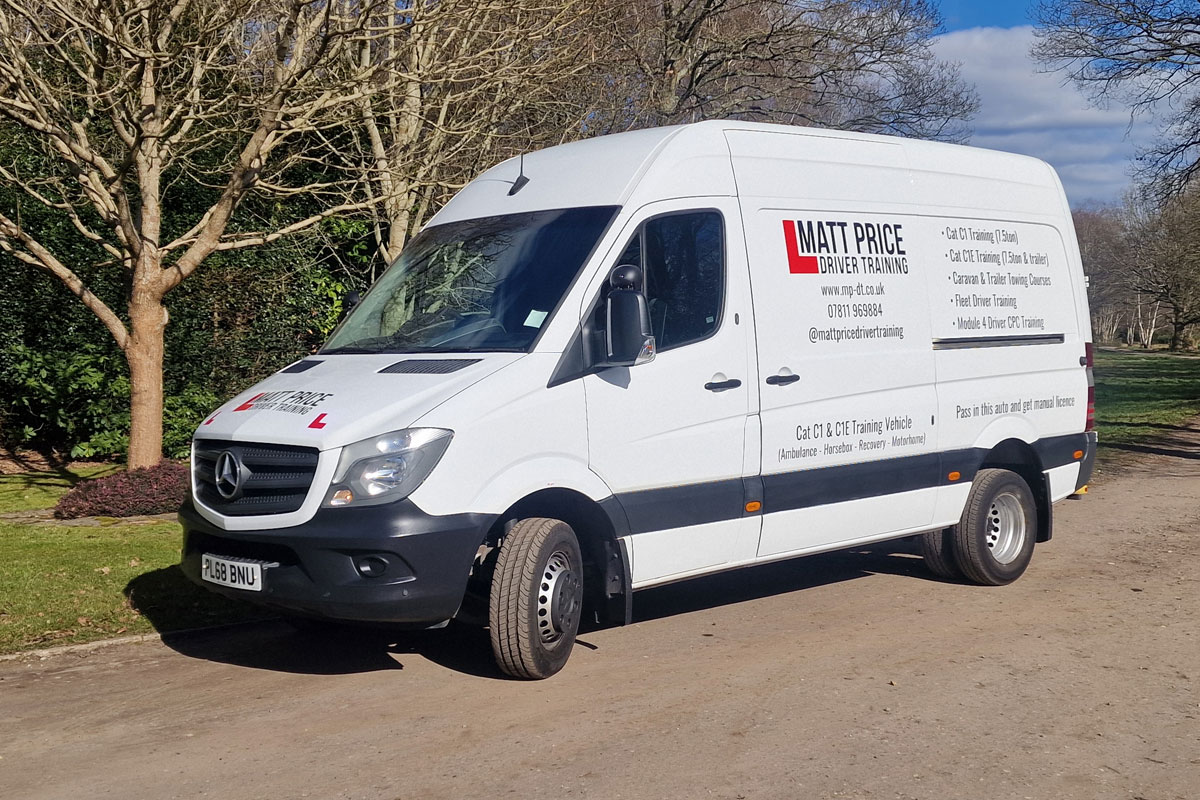
Getting a Category C1 licence allows you to drive vehicles with a Maximum Authorised Mass (MAM) between 3,500kg and 7,500kg. If you need C1 for work, a motorhome, horsebox or ambulance driving, the process involves several stages before you can take your practical driving test.
This step-by-step guide explains how to get a C1 licence, from applying for your provisional entitlement through to completing the practical tests.
Step 1: Check Whether You Need a C1 Licence
A Category C1 licence allows you to drive vehicles with a MAM of more than 3,500kg and up to 7,500kg. This can include 7.5-tonne commercial vehicles, larger motorhomes, horseboxes and many ambulances.
Whether you already have C1 entitlement can depend on when you passed your car driving test, so it is worth checking the categories shown on your driving licence before starting the application process.
Step 2: Apply for Provisional C1 Entitlement
If you don’t already have the required C1 entitlement, you’ll normally need to apply to the DVLA for provisional Category C1 entitlement.
You will need a D2 application form and a D4 medical examination report. The D4 must be completed by a doctor, with the eyesight section completed appropriately where required.
We’ve put together a separate guide explaining D2 and D4 forms and the C1 medical process.
You can also check the current application requirements on the official GOV.UK website.
Step 3: Pass the C1 Theory Tests
Once your provisional entitlement has been added to your licence, you can take the required theory tests.
These normally consist of:
- Multiple-choice theory test – 100 questions, with a pass mark of 85.
- Hazard perception test – 19 video clips containing 20 developing hazards, with a pass mark of 67.
Both parts must be passed before progressing to the C1 practical tests.
Step 4: Complete Your C1 Driver Training
Once you’ve passed your theory tests, you can begin your practical C1 driver training.
The amount of training required will depend on your existing driving experience and confidence. At Matt Price Driver Training, our standard C1 course includes approximately 12 hours of 1-to-1 practical training, including test time.
Training is carried out in our automatic C1 vehicle in the Guildford area, with all practical driving time dedicated to you rather than shared between candidates.
Step 5: Pass the Module 3a Reversing Test
Module 3a is the off-road element of the C1 practical test and assesses your ability to manoeuvre the vehicle accurately and safely through the required reversing exercise.
We conduct Module 3a tests at the DVSA-approved reversing site we use near Guildford.
Step 6: Pass the Module 3b On-Road Driving Test
Module 3b is the on-road practical driving test. It assesses your ability to drive the C1 vehicle safely in a variety of road and traffic conditions.
The test also includes a period of independent driving.
Once you’ve successfully passed both Module 3a and Module 3b, you’ve completed the practical C1 testing process.
Can I Take My C1 Test in an Automatic Vehicle?
Yes. If you already hold a full manual Category B car licence, you can complete your C1 training and practical test in an automatic vehicle and still gain manual C1 entitlement.
This means you don’t need to learn or take the test in a manual 7.5-tonne vehicle simply to retain manual C1 entitlement.
Do I Need Driver CPC for a C1 Licence?
That depends on how you intend to use the vehicle. Drivers using C1 vehicles professionally may need Driver CPC, while exemptions apply to certain types of driving.
For example, you do not normally need Driver CPC when obtaining C1 entitlement to drive an NHS ambulance, a private motorhome or a private horse lorry.
You can check the current rules and exemptions on the official GOV.UK Driver CPC guidance.
How Long Does It Take to Get a C1 Licence?
There isn’t one fixed timescale because the process depends on factors such as your medical, DVLA processing, theory test availability, practical training and test availability.
If you need your C1 licence by a particular date, such as before starting a paramedic placement or a new job, it’s sensible to begin the process as early as possible.
How Much Does C1 Training Cost?
Our standard C1 course costs £1,100 and includes approximately 12 hours of 1-to-1 practical training, including test time, together with the Module 3a reversing test and Module 3b DVSA on-road driving test.
We also offer an extended training option for candidates who would benefit from additional practical driving time.
Student paramedics and NHS staff can access our specialist discounted C1 ambulance training course.
Ready to Start Your C1 Training?
You can find full details of our course options, vehicle and practical training on our C1 Driver Training page.
If you’re a student paramedic or need C1 for an ambulance role, see our C1 Ambulance Driver Training page.
If you’re unsure where to start, get in touch with Matt Price Driver Training and we’ll be happy to advise you.