Understanding caravan weights is essential for making sure your car and caravan are correctly matched and that you stay within the relevant weight limits.
Terms such as MTPLM, MRO, payload and noseweight can seem confusing at first, but they are much easier to understand once you know what each figure represents.
This guide explains the main caravan weight terms, where to find them and how they affect your towing setup.
Caravan Weights Explained: What is MTPLM?
MTPLM stands for Maximum Technically Permissible Laden Mass. This is the maximum permitted total weight of the caravan when it is fully loaded and ready to travel.
The MTPLM includes the caravan itself together with everything you add to it, including luggage, equipment, food, water and other items carried inside.
You should never load the caravan beyond its stated MTPLM.
What is MRO?
MRO stands for Mass in Running Order. This is the weight of the caravan in the manufacturer’s specified standard condition before you add your personal belongings and other payload.
Exactly what is included within the MRO can vary between manufacturers and caravans, so it is important to check the manufacturer’s information for your particular caravan.
What is Caravan Payload?
Your caravan’s payload is essentially the difference between its MRO and MTPLM.
For example, if a caravan has:
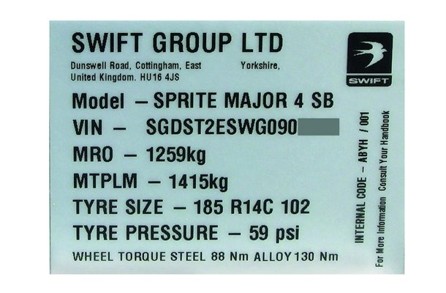
- MRO: 1,259kg
- MTPLM: 1,415kg
The available payload would be:
1,415kg − 1,259kg = 156kg payload
That 156kg has to cover the additional items you load into the caravan, subject to what the manufacturer already includes within its MRO figure.
It can be surprisingly easy to use up the available payload, so don’t assume that everything you can physically fit inside the caravan can necessarily be carried legally.
Where Can I Find My Caravan’s Weight Figures?
The important weight information can normally be found on the caravan’s identification or weight plate and in the manufacturer’s documentation.
The plate will usually include the caravan’s MTPLM and may also show other useful information such as axle limits and identification details.
If you are unsure how heavily your caravan is actually loaded, a weighbridge is the best way to establish its real laden weight.
What is Caravan Noseweight?
Noseweight is the downward force that the caravan coupling places on the towball of the towing vehicle.
Correct noseweight is important for towing stability. Too little or too much can adversely affect how the car and caravan combination handles.
As a general guide, noseweight is often around 5–7% of the caravan’s actual laden weight, but you must always stay within the permitted limits for your particular setup.
The maximum permitted noseweight is determined by the lowest applicable limit, which could include the towing vehicle, towbar or caravan manufacturer’s limit.
How Do I Know if My Car and Caravan are a Good Match?
As well as checking the manufacturer’s towing limits, you may come across the commonly used 85% towing guideline.
This compares the caravan’s MTPLM with the towing vehicle’s kerb weight:
Caravan MTPLM ÷ Car kerb weight × 100 = weight ratio
For drivers who are new to caravan towing, an MTPLM of around 85% of the car’s kerb weight has traditionally been recommended as a useful guideline. More experienced drivers may tow combinations approaching 100%.
These percentages are guidance rather than legal limits. You must still make sure that your vehicle, towbar and caravan remain within all of their manufacturer’s specified weight limits.
Why Loading a Caravan Correctly Matters
Knowing the overall weight is only part of safe caravan loading. Where the weight is positioned is also important.
As a general principle:
- Keep heavier items low down and close to the caravan’s axle.
- Avoid placing excessive weight at the very front or rear of the caravan.
- Secure items so they cannot move while travelling.
- Check your noseweight after loading.
- Make sure you remain within the caravan’s MTPLM and individual axle limits.
Poor weight distribution can have a significant effect on the stability and handling of a caravan.
Caravan Towing Training
Once you have the main caravan weights explained, the next step is understanding how they affect your towing setup in practice. Safely towing a caravan also involves practical skills such as hitching, safety checks, reversing, manoeuvring and driving the combination confidently on the road.
At Matt Price Driver Training, our caravan towing lessons provide practical, hands-on training in Farnborough for drivers from Surrey, Hampshire and the surrounding areas.
Training can cover your own car and caravan where appropriate, allowing you to practise with the combination you’ll actually be using.
If you’re new to caravan towing or would simply like more confidence with reversing and manoeuvring, find out more about our caravan towing training.