C1E Driver Training
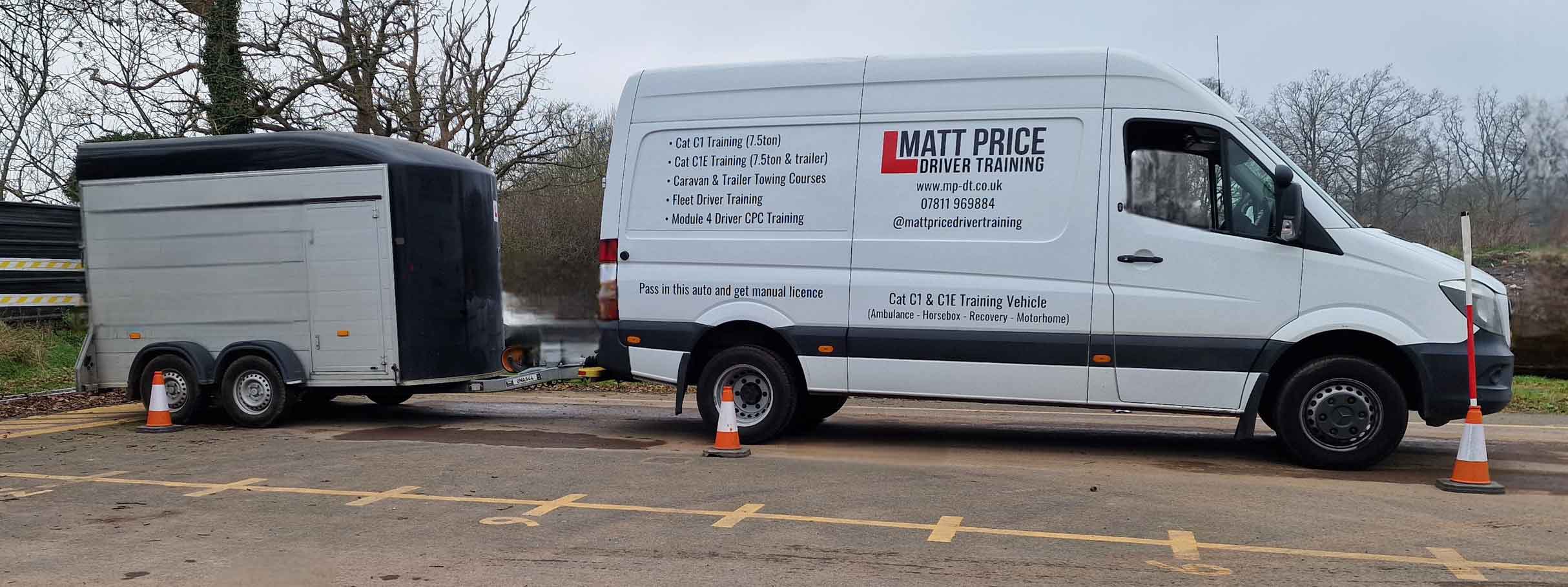
What is Category C1E?
Our C1E driver training in Guildford is designed for drivers who need to drive a Category C1 vehicle between 3.5 and 7.5 tonnes while towing a trailer over 750kg.
This entitlement is commonly required for larger vehicle and trailer combinations. Examples include horseboxes towing trailers, larger motorhomes with trailers, and certain commercial vehicle and trailer combinations.
You can train and test for C1E even if you do not currently hold Category C1. You do not need to take a separate C1 practical test first. Passing the C1E test will also give you Category C1 entitlement.
Getting Your C1E Licence
The process depends on the licence entitlement you already hold. There are three common starting points:
- Drivers with C1E through acquired (grandfather) rights
- Drivers who already hold Category C1
- Drivers who do not currently hold Category C1
C1E Through Acquired Rights
Drivers who passed their car driving test before 1 January 1997 may already have C1E entitlement through acquired rights. This normally carries restriction code 107, which limits the maximum authorised mass of the vehicle and trailer combination to 8,250kg.
To drive a C1E combination above this limit, up to the maximum permitted for the category, you will need unrestricted C1E entitlement.
If You Already Hold Category C1
Drivers who have already passed the required theory tests and gained a Category C1 licence can progress to C1E practical training and testing. There is no need to take the theory tests again.
If You Do Not Hold Category C1
Drivers progressing from a car licence may need to obtain the appropriate provisional entitlement first. The process is:
- Apply for the appropriate provisional entitlement using the D2 and D4 forms.
- Complete the required medical examination for the D4 form.
- Pass the required theory tests once your provisional entitlement has been issued.
- Complete your C1E practical training and tests.
For more information about applying for provisional entitlement, see our D2 & D4 Forms Explained guide.
C1E Theory Tests
Drivers who need to complete the theory tests must pass two parts:
- Module 1a – Multiple Choice: 100 questions covering areas such as road safety, vehicle knowledge, driving regulations and hazard awareness. You need 85 out of 100 to pass.
- Module 1b – Hazard Perception: 19 video clips containing 20 developing hazards. You need 67 out of 100 to pass.
You must pass both parts before progressing to the relevant practical tests.
C1E Practical Training & Tests
Once you have completed your theory requirements, you can begin your practical C1E training.
The practical test has two parts:
- Module 3a – Off-road exercise: You will reverse the vehicle and trailer into a bay and complete an uncoupling and recoupling exercise.
- Module 3b – On-road driving: You will complete the practical road test in the Guildford area.
Module 3a – Reversing & Coupling
You must pass Module 3a before taking Module 3b. Training covers the reversing exercise together with safely uncoupling and recoupling the trailer.
We carry out Module 3a testing in-house at our approved site. DVSA requirements prevent the person who provides your training from also conducting your test. Matt therefore works alongside another authorised trainer who conducts the assessment.
Module 3b – On-Road Driving
Matt provides all on-road C1E training on a 1-to-1 basis. This gives you dedicated driving time throughout the session.
Training focuses on developing the standard of driving required for a higher-category vehicle and trailer combination, including:
- Safe and effective use of the vehicle controls
- Moving away safely, including on gradients
- Safe positioning and stopping
- Effective use of mirrors and observations
- Appropriate use of signals
- Awareness and anticipation of other road users
- Safe management of speed and progress
- Planning and dealing with hazards
- Safe handling of the vehicle and trailer combination
The practical test also includes a period of independent driving. During this section, you will need to make safe driving decisions without continuous direction from the examiner.
The C1E Training Vehicle
For C1E driver training, we use our automatic Mercedes Sprinter together with a suitably loaded trailer that meets DVSA practical test requirements.
Using an automatic vehicle allows you to concentrate on observation, planning, positioning and controlling the vehicle and trailer combination. You can do this without having to manage a manual gearbox.
Pass in an Automatic and Gain Manual C1E Entitlement
Taking your C1E test in our automatic vehicle will not restrict you to automatic C1E vehicles if you already hold a full manual car licence.
After passing, you will retain manual entitlement for the higher category. This gives you the flexibility to drive both manual and automatic vehicles within the category.
C1E Course Options & Pricing
Standard 2-Day C1E Course – £1,150
Our standard C1E course is designed for drivers who already have experience towing trailers. It includes approximately 12 hours of 1-to-1 practical training and normally takes place over two days.
The price includes use of our C1E training vehicle and trailer. Your Module 3a and Module 3b DVSA practical test fees are also included.
Extended 3-Day C1E Course – Typically £1,400
Our extended C1E course typically costs £1,400 and provides additional training time. It includes approximately 17 hours of 1-to-1 practical training, normally arranged over three days.
Extra training time can be particularly useful if you need more practice with trailer reversing. Before booking, Matt can discuss your previous towing and reversing experience with you. This helps us recommend the most suitable course.
Pass Protection – £200
You can add Pass Protection when booking your course. Following an unsuccessful first practical test, it covers an additional two hours of 1-to-1 training and the full DVSA re-test fee.
Do I Need Driver CPC?
Your intended use of the vehicle determines whether you need Driver CPC. Drivers using C1E vehicles professionally may also need to complete the relevant Driver CPC requirements.
Some uses are exempt from Driver CPC, so you may not need to complete the CPC qualification. Examples can include NHS ambulance service use, private motorhomes and private horse lorries.
For the current exemptions and full eligibility requirements, see the GOV.UK guidance on when Driver CPC is not required.